Friday, August 15, 2008

MADE TO STICK: Why some ideas survive and others die.

Making It Stick is well worth the read, but one of the take-aways for me was their 6 principles of stickiness.  As Dan and Chip Heath pored over hundreds of sticky ideas, they saw, over and over, the same six principles at work.

SIMPLICITY
To strip an idea down to its core, we must be masters of exclusion. We must relentlessly prioritize. 

UNEXPECTEDNESS
We can use surprise — an emotion whose function is to increase alertness and cause focus — to grab people's attention. But surprise doesn't last. For our idea to endure, we must generate interest and curiosity. 

CONCRETENESS
Naturally sticky ideas are full of concrete images — ice-filled bathtubs, apples with razors — because our brains are wired to remember concrete data. In proverbs, abstract truths are often encoded in concrete language: "A bird in hand is worth two in the bush." 

CREDIBILITY
Sticky ideas have to carry their own credentials. We need ways to help people test our ideas for themselves — a "try before you buy" philosophy for the world of ideas. 

EMOTION
How do we get people to care about our ideas? We make them feel something. We are wired to feel things for people, not for abstractions. 

STORY
How do we get people to act on our ideas? We tell stories. Research shows that mentally rehearsing a situation helps us perform better when we encounter that situation in the physical environment. Similarly, hearing stories acts as a kind of mental flight simulator, preparing us to respond more quickly and effectively.

To summarize, here's their checklist for communicating a sticky concept:  a Simple Unexpected Concrete Credentialed Emotional Story

Sadly, for those who try to develop an idea like this, there is a villain. The villain is a natural psychological tendency that consistently confounds our ability to create ideas using these principles. 

It's called the Curse of Knowledge. 

Sunday, July 13, 2008

Rally your audience simply and cleverly.


I was on Dan and Chip Heath's Fast Company Blog not long ago and ran across a link to a cleverly executed microsite called GirlEffect.


The site seeks to rally audiences around complex, interwoven global development issues and suggests the solution to the world's woes has been in front of us all along.  The site invites visitors to get involved in a wide range of development initiatives that will truly make a difference in third world and developing countries. 

The online video that launches the site, and the additional resources available on the site are insightful and cleverly executed.  GirlEffect.org proves once again that impact shall triumph over completeness every time.
 

Tuesday, June 10, 2008

Reuse and recycle: The shelf life power of a great story.

I'm amazed how much large organizations spend on "single" or "limited use" videos that are played at a conference or a town hall and then tossed into the archive.  It's not unreasonable for a large corporation to spend tens of thousands on a "big opener" - video that really doesn't have any real value outside of the event.

I'm a big fan of working with my clients to develop creative approaches and themes that will not only stand the test of time, but leverage a multitude of distribution opportunities beyond the initial premiere.  

For example, have you been to a conference themed around teamwork lately?  Have you seen the fast paced video clip with the sponsoring executive extolling the virtues of working together?   Did you read the words "collaboration",  "stronger together", and "team" pulsing to the beat of a popular music track as you stare at a seemingly endless collage of photos of a politically correct mixture of employees hugging and high-fiving.   Oh wait, was that Fred from accounting in that picture?

Now, really.  Does that really inspire teamwork?  

I've found that you'll earn way more brownie points from your audience if you go out in advance and capture tangible examples of teamwork already occurring in your organization.

By theming your event around these "front-line successes" you not only demonstrate that it's achievable, but you recognize the people who are already doing it.   You will be amazed at the rise in employee engagement when you start profiling company success stories based on teamwork.

In developing a strategic, story-based approach, you can explore in greater detail the techniques and best practices being applied, personal perspectives from those "in the trenches", and inspire your audiences to take ownership and do the same.  You can edit the stories into engaging 120-second success stories for your company Intranet, or dissect the content and use the components as training resources.

Whether you roll it all into a punchy 90-second video, or spread your long-form teamwork stories throughout the organization, its up to you.   One thing is for sure, the teamwork stories you produce today will have value to your organization for months and years to come.


Wednesday, May 21, 2008

True North- A Nut company use stories to differentiate it's brand.

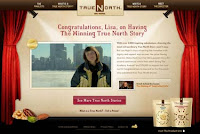
When I saw an engaging TV commercial about a committed local community leader during a visit to New York one weekend, I was compelled to go to the Web link advertised at the end of the spot.  The 60 second story about Lisa Nigro, founder of the inspiration cafe, was sponsored by True North Snacks - a Frito Lay company.


The site is the outcome of a contest, in which consumers of True North Snacks submitted stories about local heroes and voted on the winner.  The story was then captured and turned into a 60 second spot which aired during the Oscars.

So, what's a True North?  A true north is "that singular passion in life that causes you to leap out of bed in the morning and think "Why am I here?".
 
The goal was to connect True Northerners with a regionally branded nut snack and reinforce the company's commitment to social responsibility.  Upon further exploration I discovered several spots about inspiring "local" thought leaders across the northern half of the US.  All of the spots, it seems, were directed by Actress Helen Hunt and all are energizing with a high end look and feel.

There's even a behind the scenes interview with Ms. Hunt where her commitment to such social causes is shown to align nicely the brand principles of True North.  

Stories like these help to reinforce, in a memorable way, the story behind the package of flavoured nuts you come across in the convenience store.  Because you've been touched emotionally by the True North brand, you're more likely to place your trust in the product.   By purchasing it, you presumably become a more socially responsible human being. 

As the True North people state: while every True North story is unique, each one has the power to inspire millions more.   Whew, too bad we can't get them here in Canada....


Tuesday, April 15, 2008

Hitachi Real Stories - Inspire the Next

Here's a great storytelling microsite from the US division of electronics giant Hitachi:     

These well crafted, high quality docu-stories celebrate Hitachi's strategic partnerships with educators, law enforcement agencies, and health care and social service providers.   The stories reveal the innovative ways Hitachi technology is helping to improve the lives of everyday people all over the United States and a new one seems to appear on the site every several months. 

In addition to this microsite venue, I have no doubt that the videos are used widely to promote Hitachi's products, services, and social responsibility efforts at all levels of the company - internally and externally.  They bring the Hitachi brand to life in a real and meaningful way. 

I must say, stories like this have a way of connecting with audiences in multiple ways - meaning, you don't have to be a prospective customer of high tech solutions to appreciate their brand values.  What better way to communicate your brand to existing employees, prospective recruits, and strategic partners than to reward and recognize the innovators within your community.

Bookmark this site and drop back from time to time to see new material.

Wednesday, March 5, 2008

Online stories get traction

I’ve been following a great number of storytelling initiatives on the Internet lately. 

If you haven’t already, drop by globeandmail.com to browse some of the stories in their multimedia section. They are featuring a number of long-form documentaries that integrate photos, video interviews and lengthy articles. If you have 20 or 30 minutes to spare and want to tuck into something deep – this is the place to go.

globeandmail.com: The Boy in the Moon
 
If you’re hoping for quick and cheery, Home Depot is diving in with both feet in an effort capture the imagination of do-it-yourselfers of every demographic. The flagship video stories are rich [BIG budget], inspiring, and the Submit Your Story section features dozens of simple text-based stories from customers.

Blackberry, Genworth, Hitachi, and Shell all share stories that bring their brand to life. If you run across anything worth sharing drop me an email.  

Cheers, R

Monday, February 18, 2008

RBC Client First Stories

A few days ago, a friend of mine asked to see some of the many brand stories I directed for RBC. 

I directed her to rbc.com but thought that it would be worthwhile compiling a few of the public versions of the Client First Stories for others to see as well.

In addition to being the creative lead on the initiative, I directed and shot most of the two-minute internal stories.   To date, there have been almost 40 completed.  These included a half-dozen "pilots" for various divisions of the bank - stories that helped to establish the look and feel of Client First, long before the name was formalized. 

They included Steve's Auto, Muttluks, KK Plastics, and the Marshall's.

The first official Client First Story was Hilary and Dennis, the story of a young professional couple from Vancouver and the RBC Financial Planner who helped them get ahead.  

Within a few months, we had completed Abe's Story, Pierre Paquin,  Jack & Laurie and Kate. Recognizing the value of the stories both inside the organization and out, RBC established a client stories page off rbc.com.  But the real return on investment was employee engagement and alignment around the "Client First" brand principles. 

All of the stories are accessible on RBC's employee intranet, and many have been used to open town hall meetings, employee conferences, and training sessions across the RBC network.   A number of recent stories originally developed with "internal-only" objectives, have also found their way to the public site.  Notably, the story of Randy and Neil, the couple from Winnipeg whose story is now available on the Homeline Plan product page.

Grab a coffee, sit down and enjoy.